
Connected to Win: Bamboo Eagle Strengthens Allied Decision-Making
Exercise Bamboo Eagle 26-1, the U.S. Air Force’s premier large-scale combat exercise, commenced this week to test the very nervous system of joint and coalition airpower. The exercise is designed to stress the people, processes, and technology that link commanders to their forces, ensuring that thousands of service members can operate as a single, cohesive team while geographically dispersed and under threat.
Led by the U.S. Air Force Warfare Center, the exercise is not simply a test of tactical skill, but a rigorous evaluation of operational-level decision-making. This challenge requires commanders to lead and synchronize a multi-domain fight across the vast distances of a simulated modern battlespace, focusing on the speed, resilience, and integration of C2 from the strategic level down to the tactical edge.
At its core, the exercise is designed to mature the Air Force’s application of mission command: a framework of centralized command, distributed control, and decentralized execution. This philosophy empowers subordinate commanders and tactical leaders to make rapid, informed decisions in a dynamic and contested environment where communication can no longer be guaranteed.
“In any conflict, the ability to make fast, effective decisions across vast distances is decisive," said U.S. Air Force Brig. Gen. David Epperson, USAFWC commander. "Bamboo Eagle doesn't just train pilots; it pressures the entire command and control architecture—from the air operations center to the expeditionary wings. We are preparing our leaders to command the fight, not just participate in it."
The ability to project airpower globally over vast distances creates inherent C2 complexities. Mastering these complexities is a core focus of the joint force. The digital backbone that allows commanders to master these challenges is the massive live, virtual, and constructive, or LVC, environment managed by the 505th and 705th Combat Training Squadrons. While live aircraft operate in designated airspace, the LVC weaves them into a complex battlespace with thousands of virtual and constructive entities. This LVC-driven reality provides the realistic conditions needed to hone our global C2 capabilities, validating our ability to synchronize airpower and deliver decisive combat effects anywhere, anytime.
“Mastering the complexities of global C2 isn't theoretical. It has to be practiced against a realistic, large-scale threat, and that is precisely what Bamboo Eagle provides,” said U.S. Air Force Maj. David Blessman, 505th Command and Control Wing BE 26-1 exercise lead. “It creates a unique environment where the operational and tactical levels directly affect each other, which is essential for honing the air component’s nervous system from the planners to the pilots. The LVC environment is the arena where we stress our ability to synchronize forces across vast distances.”
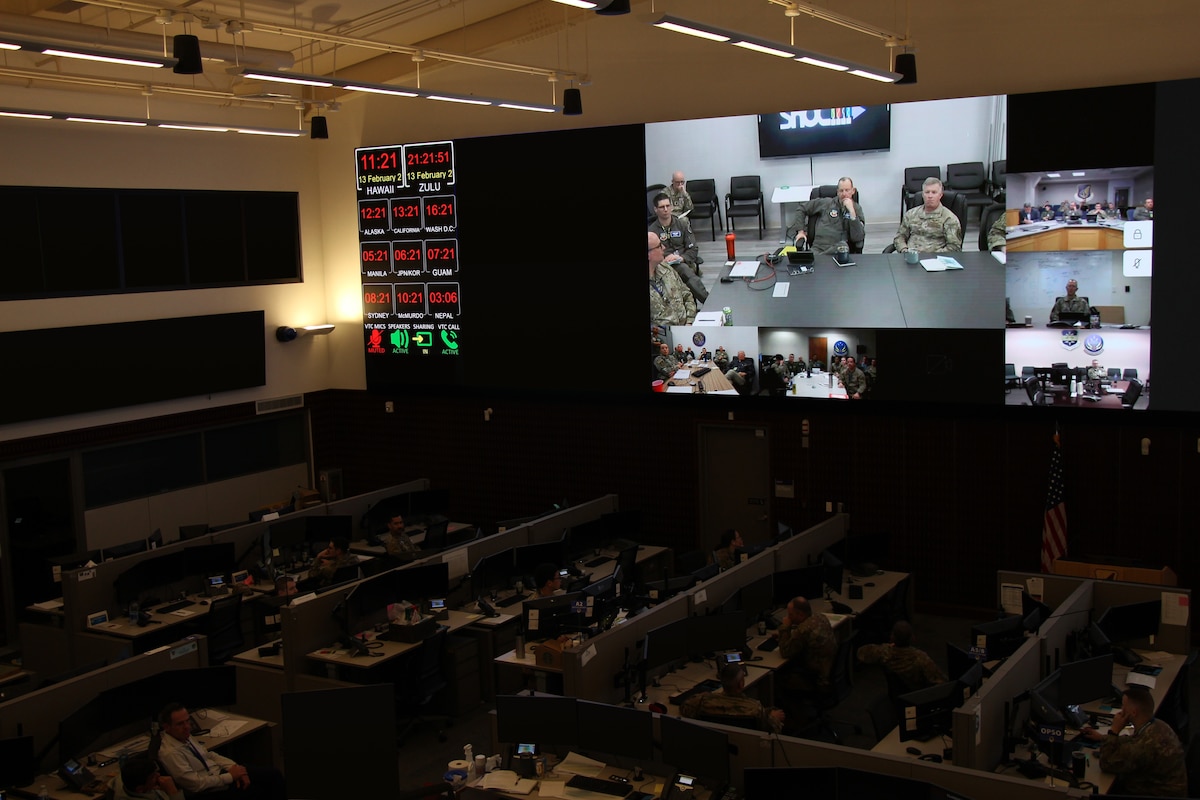
This iteration continues to strengthen the neural connections of coalition C2, a hallmark of the Bamboo Eagle series. A key to this is placing experienced C2 professionals from the Royal Air Force and Royal Australian Air Force into key leadership and planning roles within the AOC. They are directly shaping operational decisions and bringing unique combat experience to the fight, effectively grafting new, resilient pathways into the system. This deep integration builds a more adaptive network, ensuring the combined force can think and react with a unified mind.
“Bamboo Eagle demonstrates a truly unified command structure. The RAF continues to support the exercise series with an ever-increasing number of C2 experts, who are fully embedded within the AOC’s command team, contributing to the entire operational planning and execution cycle alongside the USAF and RAAF,” said United Kingdom Wing Commander Richard Kinniburgh, BE 26-1 U.K. exercise architecture lead. “When you have a team this unified, you're not just sharing data; you're building a single, resilient command and control nervous system. That is the level of interoperability required to win in a peer conflict.”
The ultimate goal of this exercise is combat readiness, and the 605th Test and Evaluation Squadron is the organization that evaluates it. Serving as expert analysts and tacticians of the force, the squadron provides a data-driven assessment of the C2 nervous system's health, and how well it produces war-winning operational outcomes. Utilizing a Mission Under Test construct, they analyze all the systems end-to-end, from the time it takes to execute a kill chain (the force's reflex arc) to the performance of data links under pressure, delivering the quantitative proof of the system's lethality and speed.
“A powerful nervous system is good; a battle-tested one is better. Our mission is to provide that test,” said U.S. Air Force Lt. Col. Brad Short, 605th Test and Evaluation Squadron commander. “We act as the neurologists for the C2 community, using objective data to confirm the strength and speed of every system and connection. We don't just look for what's broken; we look for what can be made faster and more dominant. Our analysis gives leaders the confidence that they can trust their C2 system to perform decisively in a high-end fight.”
This robust and agile C2 structure is the foundational enabler for agile combat employment, or ACE, allowing forces to generate combat power from dispersed locations while maneuvering under threat. As Bamboo Eagle 26-1 unfolds, every challenge overcome and every problem solved becomes a lesson learned, the crucial process of building the force’s collective muscle memory. Each iteration strengthens the right connections and prunes the inefficient ones, ensuring the U.S. and its allies are forging a combat nervous system that is not just functional, but truly optimized to deter aggression and win any future conflict.
“The technology that powers this exercise is incredible, but our true asymmetric advantage is trust. It’s the trust between a commander and their Airmen at the edge, and the trust between our nation and our allies,” said U.S. Air Force Col. Ryan Hayde, 505th Command and Control Wing commander. “Bamboo Eagle is the forge where that trust is built and tested. It strengthens the human connections that make the C2 nervous system work under pressure. Technology can be copied, but that level of integration and shared commitment cannot. That is what makes this coalition unbeatable.”
